We published this guide in June 2019. Without false modesty, it was one of the most complete ones out there. Seven years later almost nothing it said is still true word for word, so we have rewritten the whole thing with 2026 data.
What has not changed is the substance. SEO is still about getting people to find you at the moment they need you. What has changed is the stage: Google no longer always returns ten blue links, and a growing share of answers is written by an AI model that decides who gets cited. This guide covers both.
Table of contents
- What is SEO?
- Is SEO still worth it in 2026?
- How search works today
- From RankBrain to generative answers
- E-E-A-T, YMYL and authority
- The factors that move the needle in 2026
- What we removed from the 2019 guide
- GEO: SEO when the answer comes from an AI
- Penalties and spam policies
- The tools we work with
- Frequently asked questions
What is SEO?
SEO (Search Engine Optimization) is the work of getting your pages to show up organically, without paying for the click, when someone searches for what you offer.
That definition has held since 1997 and it still holds. What has grown is the perimeter: today "showing up" means appearing in Google's results, but it also means being the source an AI model chooses to cite when it writes its answer.
The craft breaks down into four legs that do not stand on their own:
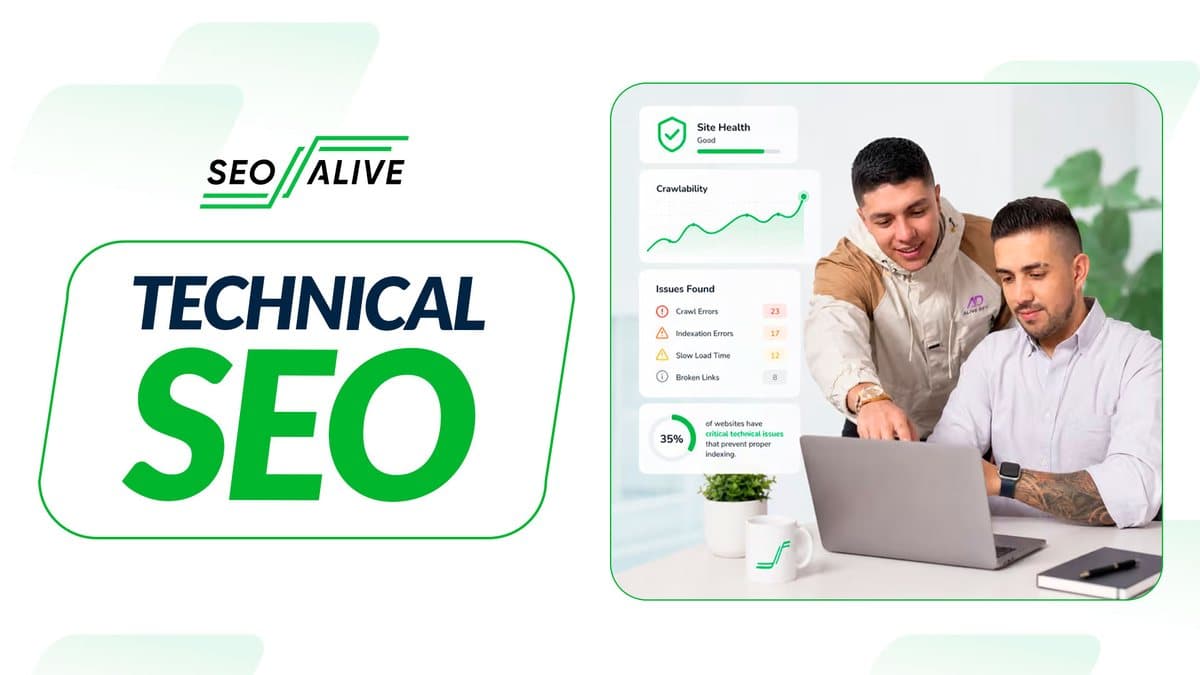
- Technical SEO keeps the site crawlable, indexable and fast.
- On-page SEO matches each page to the intent the user arrives with.
- Off-page SEO builds authority through links and brand mentions.
- Content marketing produces the pages that answer the query.
Is SEO still worth it in 2026?
Every year somebody announces the death of SEO. This year the argument is AI, and for the first time it is partly right: AI summaries do take a share of the clicks. It pays to look at the numbers instead of the opinions.
The most solid study available right now is Seer Interactive's (April 2026, 53 brands, 5.47 million queries and 2.43 billion organic impressions). What it measures:
- When there is no AI summary, the average organic CTR is 3.82 %.
- When there is one, it drops to 2.36 %.
- Summaries appear on 36 % of informational queries, but on only 8 % of commercial and 5 % of transactional ones.
- And the key figure: being cited inside the summary gives you 120 % more clicks per impression than not being cited.
Translated into what it means for a business: commercial search, the kind that pays the bills, is still almost untouched, and on informational queries the damage lands on whoever is not cited. The conclusion is not to stop doing SEO, it is to do it for both scenarios.
An example with today's data. In Spain, "agencia seo" gets 6,800 monthly searches, "seo" 19,000, "posicionamiento seo" 3,500 and "posicionamiento web" 2,300 (Ahrefs, September 2026). With a realistic CTR in the top positions, ranking first for "agencia seo" still moves somewhere in the region of 1,500 to 2,000 visits a month from people searching for exactly what you sell, against a reference CPC of €1.90. That same traffic, bought through Ads, is several thousand euros a month, every month.
How search works today
The old circuit is still running underneath, and understanding it is what separates people who do SEO from people who publish posts and wait:
- Crawling. A bot discovers your URLs by following links and sitemaps.
- Rendering and indexing. It executes your page, understands it and decides whether it deserves a place in the index.
- Ranking. Given a query, it orders what it has indexed by relevance, quality and context.
- Presentation. It decides how to show it: links, snippets, a generated summary, a local pack…
If you fail at step 1 or 2, the other two do not exist. It is the most expensive and most common mistake we find in audits: sites that treat their content with care while a noindex left over from a migration or an over-aggressive robots.txt hides half a section.
Keywords and search intent
We still use keywords as the unit of measurement, but what you optimize for is intent: the need behind those words. The same intent gets expressed through dozens of different queries, and the same query can hide opposite intents.
There are three big families, and deciding which one your keyword falls into is the first thing we do in a keyword research project:
- Informational: wants to understand something ("what is seo"). This is the one most exposed to AI summaries.
- Navigational: wants to reach a specific place ("seo alive").
- Commercial or transactional: wants to compare or buy ("seo agency in madrid"). This is where the money is and where AI bites least.
Tip: before you write anything, search your keyword and look at what is already ranking. The type of page Google rewards is telling you, for free, which intent it has decided to serve. If all ten results are comparison posts and you write a product sheet, no amount of content will save you.
From RankBrain to generative answers
The timeline is worth understanding, because it explains why the tactics of ten years ago no longer work:
- 2015, RankBrain. Google starts interpreting queries it has never seen instead of just matching words.
- 2019, BERT. The model understands the context of a word by looking at what sits to its left and right. A definitive goodbye to keyword density.
- 2023-2024, generative summaries. Google starts writing answers above the results and citing sources inside them.
- 2025-2026, conversational search. A growing share of queries never reaches Google at all: they happen in ChatGPT, Gemini, Perplexity or Copilot.
The practical advice has been the same for a decade and still holds: don't write for whichever algorithm is in fashion, write for the user and make it easy for a machine to read. The first earns you relevance; the second, extractability.
E-E-A-T, YMYL and authority
The old EAT gained an extra E in December 2022 and is now E-E-A-T: Experience, Expertise, Authoritativeness, Trustworthiness.
The first E is the one most people skip and the one that shows the most: Google wants signals that whoever is writing has used the product, been to the place or done the work. It is not a ranking factor you can measure in a box; it is the framework its quality raters use to judge a page, and what eventually gets reflected in the algorithm.
It weighs double in YMYL (Your Money, Your Life) sectors: health, finance, legal, safety. There, a page with no identifiable author, no sources and no trace of who stands behind what it says does not compete.
Tip: sign your articles with real people who have their own profile page, link to their professional profiles, cite sources with a link and give an honest review date. Changing the date without touching the content is exactly what Google calls false freshness.
The factors that move the needle in 2026
Ordered by what we genuinely see moving across the projects we run.
1. Answering the intent better than whoever is ahead of you
This is not a technical factor, it is the factor. If your page covers the intent worse than the one in first place, no amount of later optimization fixes it.
2. Clean crawling and indexing
Make sure robots.txt does not block anything important, that no inherited noindex is left behind, that the canonical points where it should and that useful pages sit fewer than three clicks from the homepage.
Tip: use Search Console's URL inspection for critical pages and a crawler for everything else. We do it with SEOcrawl AI, which also flags when one of those signals changes without anyone asking for it.
3. Unique content with a point of view
Every page gets its own title, its own URL and content that does not exist anywhere else on the site. Internal duplicate content is still the number one silent leak, especially in ecommerce with filters and parameters.
4. Links: quality far above quantity
You can rank without links in quiet niches. As soon as there is competition, you cannot. What counts today is the topical affinity of the site linking to you, far more than its authority metric: a link from a small outlet in your sector is worth more than a generic one from a national newspaper. We go deeper in our guides to link building and link affinity.
5. Brand: searches and mentions
The volume of people searching for you by name is one of the hardest signals to fake, and one of those that correlates best with visibility, including inside AI answers: models cite entities they recognize.
6. Freshness and content maintenance
Well-maintained evergreen content is the most profitable asset a blog has. This very guide is the example: seven years, three rewrites.
Tip: once a quarter, take your ten pages with the most impressions and the fewest clicks and rewrite them before publishing anything new. It pays better than any article written from scratch.
7. Titles and descriptions that earn the click
With fewer clicks to go around, CTR matters more than ever. The benchmarks we still use: a title of 50 to 60 characters (or around 600 px) and a meta description of 140 to 160. Google rewrites your title when it does not match the query; give it few reasons to.
8. Core Web Vitals
The three current metrics: LCP under 2.5 s, INP under 200 ms (it replaced FID in March 2024) and CLS under 0.1. They are not a decisive ranking factor, but they are a tiebreaker and, above all, money: every second of waiting is paid for in conversion.
9. Structured data
Article, Organization, Product, FAQPage and Breadcrumb schema wherever they apply. It will not push you up the rankings on its own, but it makes you legible: for Google's rich results and for the models reading your page looking for data to quote.
10. Architecture and URLs
Readable URLs, a tree hierarchy and marked-up breadcrumbs. If someone cannot understand your URL by reading it out loud, you have work to do.
11. Images
Contained file size, modern formats (WebP or AVIF), a descriptive filename and an alt that actually describes the image. The alt is also one of the few places where alternative text reaches whoever cannot see the image exactly as written: a screen reader or a model.
12. International: hreflang
If you have several languages or several versions of the same language (es-ES versus es-MX), hreflang stops being optional. Badly implemented, Google chooses for you and usually chooses wrong: it is the single failure we have seen send Spanish traffic to the English version of a site most often.
13. HTTPS
It is not an advantage, it has been a requirement since 2018. If you still do not have it, that is your only job today.
14. Sitemaps, parameters and crawl budget
A clean sitemap (indexable URLs only, with a real lastmod), parameters under control and no sending the bot through a maze of filters. On large sites, crawl budget is a finite resource that gets spent.
15. Local SEO
If you sell from a physical location, your local SEO starts with the Google Business Profile (the old My Business), reviews and consistent contact details across the web. Google weighs relevance, proximity and prominence, and reviews count in all three.
What we removed from the 2019 guide
Just as important as what we added:
| In the 2019 guide | What happens in 2026 |
|---|---|
| AMP | Dead. Google withdrew its preferential treatment in 2021 and has been switching off the infrastructure. If you still run it, remove it. |
| Social signals as a factor | Not a direct ranking factor. They help distribution and brand mentions, which do count; the impact is indirect. |
| Keyword density | Buried since BERT. Write naturally and cover the topic, not the word. |
| "The top 10 take 100 % of the clicks" | Not any more. Two out of every three searches end without a click on an organic result. |
| Domain age as an advantage | Google has denied it is a factor. What correlates is what an old domain tends to have accumulated: links, brand and content. |
GEO: SEO when the answer comes from an AI
GEO (Generative Engine Optimization) is the discipline of getting cited inside a generated answer, not of appearing in a list. It does not replace SEO: it leans on it, because a model can only cite pages that exist, get crawled and are understood.
What does change is how you write and how you measure:
- Write in self-contained passages. A paragraph that answers a whole question on its own is a quotable paragraph. One that depends on the three before it is not.
- Put in data, figures and dates. Models cite the specific and skip the generic.
- Name entities. Brands, products, places and people, written the way they are actually called.
- Measure citations, not positions. Search Console will not tell you whether you appear in an AI summary: those impressions are mixed in with everything else. You need to monitor prompts.
We break it down engine by engine in our guides to GEO vs SEO, how to rank in ChatGPT, in Perplexity, in Gemini, in AI Overviews, in Claude and in Copilot, plus our GEO services hub.
Penalties and spam policies
A penalty is what Google imposes when you break its anti-spam policies, and it can be algorithmic (an update eats you) or manual (a human reviewer applies it and you see it in Search Console).
The effect ranges from losing one keyword to the whole domain being deindexed. The three causes that have given us the most work lately:
- Site reputation abuse: renting a subdirectory to a third party so they can rank off the back of your domain.
- Scaled content with no value: publishing at volume, with or without AI, without adding anything of your own. The problem was never the tool, it is the "without adding anything".
- Link schemes, both inbound and outbound.
Getting out of a penalty is slow: audit, fix, file a reconsideration request and wait months. It is vastly cheaper not to get into one.
The tools we work with
- Google Search Console: free, mandatory and the only source of truth on how Google sees you.
- SEOcrawl AI: our platform for crawling, watching for changes and tracking visibility in search engines and in AI models from the same place.
- Ahrefs: links, keywords and competitor analysis.
- Screaming Frog: the scalpel for one-off technical audits.
- PageSpeed Insights: Core Web Vitals with real field data.
In summary
SEO in 2026 asks for the same things as always, done better: understand who is looking for you, deserve the result and make it easy for the machine. What is new is that there are now two machines, the one that orders links and the one that writes answers, and both drink from the same well-built website.
Want to know where to start in your case? Ask for an SEO and GEO audit: we will tell you what is holding your site back today and what would move first. Or take a look at our case studies if you would rather see results before talking.
Frequently asked questions
What is SEO in a nutshell?
SEO is the set of techniques that gets your site to appear organically, without paying for the click, when someone searches for what you offer. It covers technical work, content and domain authority, and in 2026 it also includes being cited inside AI-generated answers.
How long does SEO take to produce results?
Three to six months to see real movement, and longer in competitive sectors. Technical fixes can show up in weeks; building authority and ranking new content for contested queries takes months. Anyone promising you the number one spot in thirty days is selling you something else.
Has AI killed SEO?
No, but it has changed where the game is won. AI summaries cut CTR on informational queries (from 3.82 % to 2.36 % on average, according to Seer Interactive in 2026), while commercial and transactional queries barely show them at all. And being cited inside the summary gives 120 % more clicks per impression than being left out.
Can I do SEO myself?
Yes, the fundamentals. A crawlable site with good architecture and honest content about something you know well will rank for low-competition queries. Competitive SEO (large sites, national keywords, YMYL sectors) demands tools, experience and a team.
What is the difference between SEO and SEM?
SEO is organic traffic and SEM is paid. Both attack the same channel and work well together: SEM gives you data and traffic from day one, SEO builds an asset that does not switch off when you stop spending. We compare them in depth in SEO vs SEM.
Do you still need AMP?
No. Google withdrew preferential treatment for AMP pages in 2021 and has been dismantling the infrastructure. What matters today is your site's real speed, measured with Core Web Vitals.