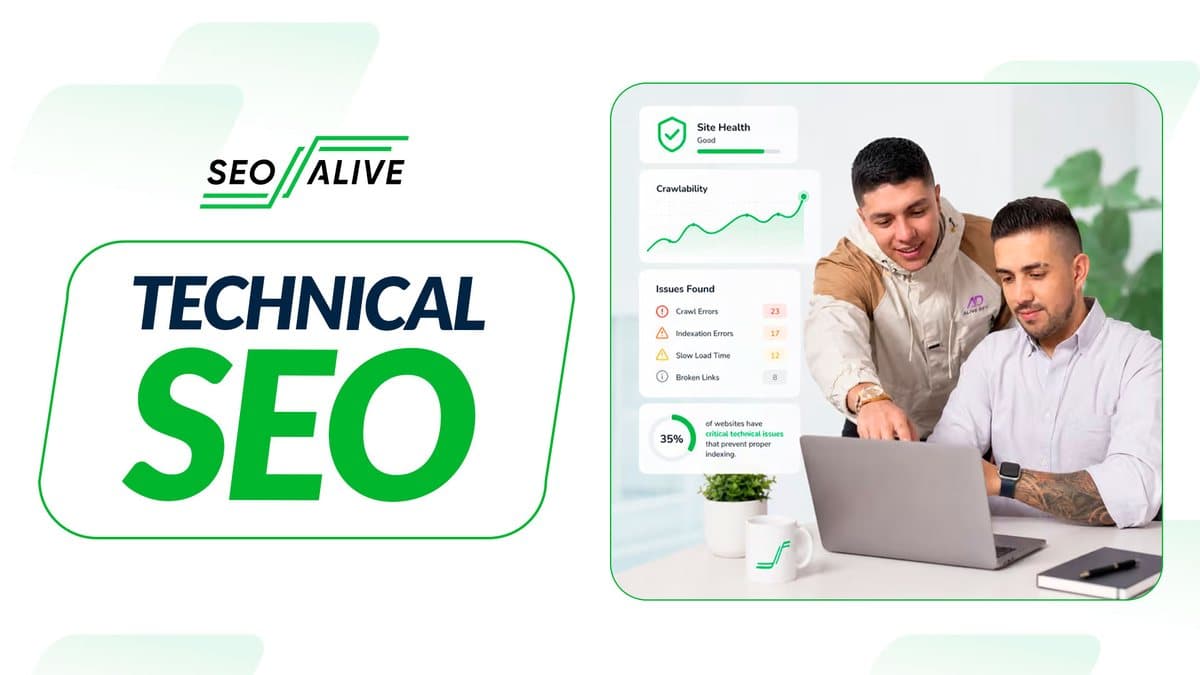
Technical SEO is the work of optimizing your website's infrastructure so search engines and AI systems can crawl, render, index, and cite your content. We treat it as the layer that determines whether your pages appear in Google's AI Overviews, Copilot's answers, and Claude's responses, not just whether they rank in blue links.
Table of contents
- Key takeaways
- What is technical SEO?
- Why technical SEO matters more in 2026
- Crawlability: the first bottleneck
- Indexability: getting into the index
- Site speed and Core Web Vitals
- Structured data: helping AI understand your pages
- Mobile-first indexing
- Technical SEO for LLM retrieval: the angle no guide covers
- Technical SEO checklist
- Frequently asked questions
Key takeaways
- Technical SEO covers crawlability, indexability, site speed, structured data, mobile-first design, and architecture. Every pillar maps to a specific bottleneck in how search engines and LLMs retrieve your content.
- Google's AI optimization guide confirms that generative AI features rely on the same core ranking and indexing systems as regular search. Technical SEO is not separate from AI visibility; it is the prerequisite.
- IndexNow lets you push URL changes to Bing and other engines in real time, which matters because Microsoft Copilot pulls answers from Bing's index.
- Structured data helps Google understand your pages and enables rich results. Rotten Tomatoes measured a 25% higher CTR on pages with structured data, and Nestlé saw an 82% higher CTR on rich result pages, per Google Search Central case studies.
- None of the top-ranking guides for “technical seo” cover how crawlability and schema affect LLM retrieval. We do, because that is where search is heading.
What is technical SEO?
Technical SEO is the discipline of optimizing your website's server, code, and architecture so that search engines can find, crawl, render, and index your pages. Without it, content does not get indexed, and content that is not indexed cannot rank or be cited by AI systems.
Google's own Search Central documentation organizes technical SEO around two tasks: controlling how Google crawls and indexes your site, and helping Google understand your content. The first covers robots.txt, sitemaps, canonical tags, and redirects. The second covers structured data, mobile-first indexing, and site architecture.
The AI Overview currently showing for “technical seo” defines five core pillars: crawlability, indexability, site performance, structured data, and mobile friendliness. Every technical SEO audit we run checks these five first, because they determine whether your content reaches the index at all.
Why technical SEO matters more in 2026
Google's generative AI optimization guide, updated July 2026, states that AI Overviews and AI Mode are “rooted in our core Search ranking and quality systems.” The guide describes two mechanisms that connect technical SEO to AI visibility directly:
- Retrieval-augmented generation (RAG): Google's AI retrieves relevant pages from its Search index to generate answers. If your page is not indexed or not crawlable, it cannot be retrieved.
- Query fan-out: The model generates concurrent related queries and fetches additional results. Pages that rank for fan-out queries get cited even when they do not match the original query exactly.
This means a technical SEO problem is not just a ranking problem. It is a citation problem. A blocked robots.txt directive, a misconfigured canonical, or a slow server response can remove your content from the pool of pages Google's AI considers when writing an answer.
The same logic applies outside Google. Microsoft Copilot pulls from Bing's index, so pages not indexed in Bing are invisible to Copilot. Claude can cite web sources through its search integrations, but only if those sources are crawlable. Perplexity always cites its sources with clickable links, but the sources it picks come from its own crawl and ranking pipeline.
Crawlability: the first bottleneck
Crawlability is the question of whether search engine bots can access your pages at all. If bots are blocked, nothing downstream works.
Robots.txt and server errors
Your robots.txt file tells bots which paths they may crawl. A misconfigured directive can block an entire section of your site. Check it in Google Search Console with the robots.txt report, and in Bing Webmaster Tools under Site Explorer.
Server errors are the other common blocker. If your server returns 5xx responses when bots request pages, Google will eventually stop crawling those URLs. Monitor your crawl stats report in Search Console for 404 and 5xx patterns.
JavaScript rendering and crawlability
Google can process JavaScript, but JavaScript-heavy pages are harder to crawl. If your content renders only after JavaScript execution, Google needs a second render pass, which consumes crawl budget. For critical content, use server-side rendering or pre-rendering so the HTML response contains the text you want indexed.
Google's own documentation covers JavaScript SEO basics and recommends testing with the URL Inspection tool in Search Console to see what Googlebot actually renders.
Indexability: getting into the index
A page can be crawlable but not indexable. Indexability is about whether Google decides to store your page in its index after crawling it.
Canonical tags and duplicate content
Canonical tags tell Google which version of a URL to index when duplicates exist. Without them, Google may index the wrong version or split ranking signals across multiple URLs. Implement rel="canonical" on every page, pointing to the preferred URL.
Duplicate content wastes crawl budget. Google's Search Central documentation recommends reducing duplicate content because “search engines might waste crawling resources on URLs that you don't even care about.”
Noindex tags
The noindex directive tells Google not to index a page. Use it for thin pages, search result pages, or staging environments. But be careful: a stray noindex on a page you want ranked will remove it from search results entirely. Check for accidental noindex tags in Search Console's URL Inspection tool.
XML sitemaps
Submit an XML sitemap through Search Console and Bing Webmaster Tools. Sitemaps help engines discover new and updated content faster. For large sites, split sitemaps by content type and keep each file under 50,000 URLs.
Site speed and Core Web Vitals
Site speed affects both rankings and user experience. Google's Core Web Vitals measure three metrics: Largest Contentful Paint (LCP), Interaction to Next Paint (INP), and Cumulative Layout Shift (CLS).
Google's page experience documentation confirms that page experience is a ranking factor, though not a dominant one. The practical impact is that slow pages lose clicks: users abandon pages that take more than a few seconds to load, and Google's crawl budget shrinks for slow servers.
For AI visibility, speed matters indirectly. Google's AI optimization guide lists “provide a good page experience” as one of the technical best practices that apply to generative AI features. Fast pages get crawled more frequently, which means new content reaches the index faster and becomes available for AI retrieval sooner.
Practical fixes
- Compress images and serve them in WebP or AVIF formats.
- Use a CDN to reduce latency for users and bots.
- Minify CSS and JavaScript, and defer non-critical scripts.
- Implement lazy loading for below-the-fold images and videos.
Structured data: helping AI understand your pages
Structured data is standardized markup that tells search engines what your content is about. Google recommends JSON-LD as the easiest format to implement and maintain.
The evidence for structured data
Google's own documentation includes case studies with real numbers:
- Rotten Tomatoes added structured data to 100,000 pages and measured a 25% higher CTR compared to pages without it.
- Nestlé measured an 82% higher CTR on pages that appear as rich results.
- The Food Network converted 80% of its pages and saw a 35% increase in visits.
These numbers come from Google Search Central, the entity that produces the data. They are not estimates from third-party tools.
Structured data and generative AI
Google's AI optimization guide says structured data “isn't required for generative AI search” but recommends continuing to use it “as part of your overall SEO strategy.” The guide also says overfocusing on structured data for AI is unnecessary.
We take a measured position: structured data helps Google understand your content, which improves your chances of being retrieved for the right queries. Whether that retrieval leads to a blue link or an AI citation, the markup does its job. The schemas that matter most for content sites are BlogPosting, Organization, BreadcrumbList, and ImageObject.
Mobile-first indexing
Google uses mobile-first indexing, which means it crawls and indexes the mobile version of your site. If your mobile site has less content than your desktop version, Google indexes the reduced version.
Check your pages on mobile for the common issues: text too small to read, clickable elements too close together, and content wider than the screen. Fix these because they affect both rankings and how AI systems render your pages.
Google's mobile-first indexing documentation is the primary source for this requirement. It confirms that Google “uses the mobile version of a site's content, crawled with the smartphone agent, for indexing and ranking.”
Technical SEO for LLM retrieval: the angle no guide covers
This is where our approach diverges from the top-ranking guides. Every guide we reviewed covers crawlability, indexing, and site speed. None of them explains how technical SEO affects whether your content gets cited by Claude, Copilot, Gemini, or Perplexity. We do, because this is the gap between ranking in search and being visible in AI.
IndexNow: real-time indexing for Bing and Copilot
IndexNow is a free, open-source protocol developed by Microsoft Bing. When you publish or update content, IndexNow notifies participating search engines immediately, instead of waiting for their crawlers to discover the change.
This matters for Copilot visibility. Microsoft Copilot generates answers using Bing's index, so pages that are indexed faster in Bing become available to Copilot sooner. If you publish a new page and wait for Bing's crawler to find it, you lose days or weeks of potential AI visibility. With IndexNow, the notification is near-instant.
Implementation is straightforward. You generate a key, host it on your server, and send a POST request to the IndexNow API with your updated URLs. Many CMS platforms and CDNs have built-in support.
If you want help setting up IndexNow and monitoring your Bing visibility, our Copilot SEO services cover the full implementation and ongoing performance tracking.
Crawlability for Brave Search and Claude
Claude, Anthropic's AI assistant, can access web content through search integrations. Brave Search is one of the sources Claude uses for real-time information retrieval. If your robots.txt blocks Brave's crawler, or if your content is not discoverable through Brave's index, Claude cannot cite you.
Check your robots.txt for blocks on user-agents like BraveBot or generic crawlers. Allow legitimate search engine crawlers unless you have a specific reason to block them. The same principle applies to other LLM crawlers: blocking them prevents AI systems from learning what your site offers.
We audit how Claude and other LLMs interact with your site as part of our Claude SEO services, including crawlability for the search engines Claude relies on.
Schema for Gemini and Google AI
Gemini powers Google's AI Overviews and AI Mode. While Google says no special schema is needed for generative AI, the structured data you already have helps Gemini's retrieval system understand what your content is and when to surface it.
The practical approach: implement Organization schema with accurate sameAs links to your profiles, BlogPosting or Article schema with datePublished and dateModified, and BreadcrumbList for navigation context. These schemas give Gemini's RAG pipeline structured signals about your content's freshness, authorship, and topical relevance.
Our Gemini SEO services include a structured data audit specifically for Google's AI ecosystem.
Perplexity and crawlable citations
Perplexity always cites its sources with clickable links, which makes AI visibility measurable as real traffic. But Perplexity's crawler needs to reach your pages, and its ranking pipeline needs to consider them relevant.
Ensure your server responds quickly to PerplexityBot and that your pages have clean, extractable content. Pages that require JavaScript to render their main text are harder for Perplexity to parse and cite. Server-side rendering helps here too.
Our Perplexity SEO services focus on making your brand one of the sources Perplexity picks, so AI visibility becomes real traffic.
Technical SEO checklist
Here is a practical checklist you can run on any site. We organize it by priority: things that block indexing come first, because they remove your content from the pool entirely.
Crawl and index
- Submit XML sitemap to Google Search Console and Bing Webmaster Tools.
- Check robots.txt for accidental blocks on important paths.
- Verify canonical tags on every page, pointing to the preferred URL.
- Check for stray
noindextags in Search Console's Pages report. - Monitor crawl stats for server errors and redirect chains.
Performance
- Run PageSpeed Insights on your key pages and fix LCP, INP, and CLS issues.
- Compress images, enable a CDN, and defer non-critical JavaScript.
Structured data and AI visibility
- Implement
BlogPosting,Organization, andBreadcrumbListschema in JSON-LD. - Validate with the Rich Results Test.
- Set up IndexNow for real-time Bing indexing.
- Check your robots.txt for blocks on AI crawlers (BraveBot, PerplexityBot, GPTBot).
- Verify your site is included in Search Console's generative AI features.
Architecture and international
- Use a flat architecture where important pages are within 3 clicks of the homepage.
- Implement hreflang for multilingual sites. Our international SEO guide covers hreflang implementation in depth.
- Use breadcrumb navigation with structured data.
Ongoing monitoring
- Monitor Search Console's Performance and Generative AI performance reports weekly.
- Check Bing Webmaster Tools for indexation status and AI performance.
- Run a full technical SEO audit quarterly to catch regressions.
For how the technical layer connects to on-page optimization, our on-page SEO services cover content signals, title tags, and internal linking.
If you want a full audit of your technical SEO with a focus on AI visibility, our AI Overview SEO services cover crawlability, indexing, structured data, and real-time monitoring across Google, Bing, and LLM crawlers.
Frequently asked questions
What is technical SEO?
Technical SEO is the practice of optimizing your website's infrastructure so search engines can crawl, render, index, and cite your content. It covers robots.txt, sitemaps, canonical tags, site speed, structured data, and mobile-first design. Without it, your content may not reach the index at all.
What are some examples of technical SEO?
Examples include submitting an XML sitemap to Search Console, implementing canonical tags to prevent duplicate content issues, adding JSON-LD structured data for BlogPosting and Organization, setting up IndexNow for real-time Bing indexing, and fixing Core Web Vitals issues like slow LCP or layout shift.
Is SEO dead now with AI?
No. Google's AI optimization guide confirms that “the best practices for SEO continue to be relevant because our generative AI features on Google Search are rooted in our core Search ranking and quality systems.” Technical SEO is the prerequisite for AI visibility: if your pages are not crawlable and indexed, no AI system can retrieve or cite them.
Can ChatGPT do SEO?
ChatGPT can help draft content, generate meta descriptions, and suggest keyword ideas, but it cannot perform a technical SEO audit. Crawl analysis, server response checking, structured data validation, and indexation monitoring require tools like Search Console, Bing Webmaster Tools, and dedicated crawlers. Technical SEO needs human expertise and diagnostic tools, not just a language model.
How long does a technical SEO audit take?
A technical SEO audit for a mid-size site typically takes 3 to 5 days of hands-on analysis, depending on the number of URLs, the complexity of the architecture, and whether JavaScript rendering is involved. The audit covers crawl errors, indexation status, Core Web Vitals, structured data, and AI crawlability. Implementation of the findings takes longer and depends on developer availability.
Ready to make your infrastructure a citation magnet? We audit crawlability, indexing, structured data, and how your pages reach Google's AI Overview, Copilot, Claude, and Perplexity. Start your technical SEO strategy with SEO Alive.