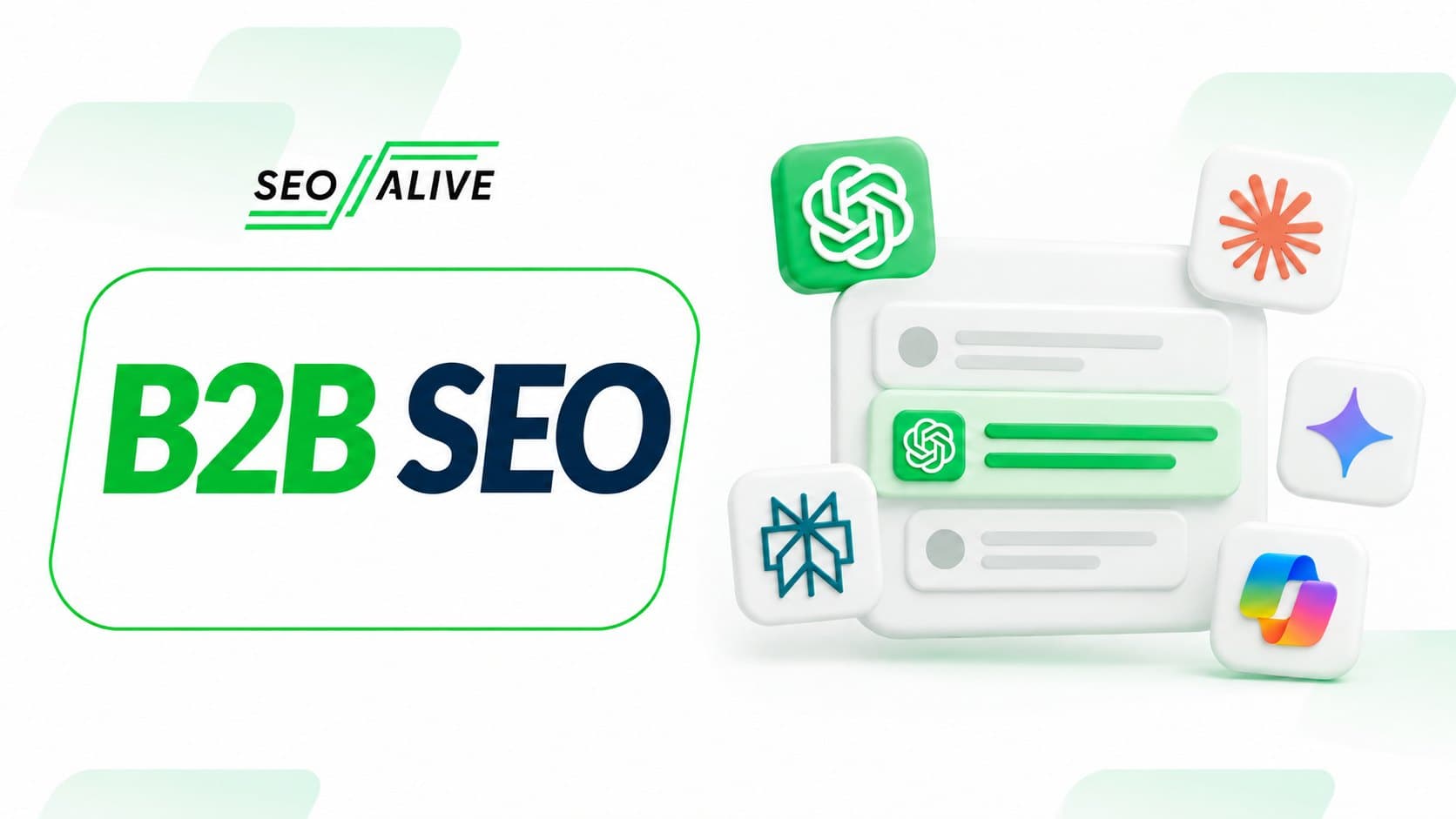
Claude reads its training data and, when a user turns on web search, pulls fresh sources through Brave. Appearing in Claude means being one of the sources it reaches for when it writes the answer.
At SEO Alive, we treat Claude as its own GEO surface. It matters more than its traffic share suggests because of who uses it: Fortune 100 teams, developers, and enterprise buyers. This guide covers what "appearing" in Claude actually means, how ClaudeBot and Brave Search feed the model, the steps that move citation rate, and how to audit whether Claude recommends you today.
But there are two layers to this visibility. Getting cited means the model attaches a link or a named source to a passage of its answer. Getting recommended means it names you first when someone asks who to use for something in your category. Both count, and they don't earn the same way.
Anthropic reports more than 100,000 businesses on its API, and Claude runs inside a large share of enterprise workflows. The people reading a Claude answer are usually researching vendors, not browsing casually. That's who a citation puts you in front of.
Table of contents
How does Claude find your content?
Claude gets information from two crawlers, and both have to be reachable.
First, ClaudeBot indexes the open web for Anthropic's training runs. What ClaudeBot ingests today shapes what Claude knows about your brand months from now.
BraveBot indexes for Brave Search, the backend Claude queries in real time when a user enables web search. What BraveBot has today is what Claude can pull today.
If you block either, you block a different visibility surface. Both are named user agents that honor robots.txt.
Watch out! Many CMS platforms block AI crawlers by default without their teams knowing.
Configuring robots.txt for ClaudeBot and BraveBot
This is the clean pattern for a site that wants to be reachable by Claude, according to Anthropic's own documentation:
User-agent: ClaudeBot
Allow: /
User-agent: anthropic-ai
Allow: /
User-agent: BraveBot
Allow: /
Claude vs ChatGPT, Gemini, Perplexity
The four engines answer the same query with different retrieval stacks. Optimizing for one doesn't automatically cover the others.
| Engine | Data source | Web search backend | What lifts you |
|---|---|---|---|
| Claude | Training data + Brave Search (when on) | Brave Search | Evergreen depth + Brave indexation |
| ChatGPT | Training data + Bing (browsing mode) | Bing | Cross-source mentions |
| Gemini | Google index + Knowledge Graph | Google index (grounding) | Classical SEO + entity strength |
| Perplexity | Own crawler + open web | Own crawler | Citation density across sources |
How you spend your GEO time for Claude depends on two of those columns. First, Brave Search is the web backend, not Bing and not Google. Second, Claude leans harder on evergreen depth than on freshness, which shapes what content actually earns citations.
Check our guides on the rest of the AI platforms:
- How to Rank in ChatGPT
- How to Rank in Google AI Overviews
- How to Get Cited by Gemini
- How to Rank in Perplexity
- How to Appear in Microsoft Copilot
Seven steps to appear in Claude
When we book a client at SEO Alive, these are the seven steps we use to point Claude's radar to their brand.
- As we mentioned, allow ClaudeBot and BraveBot in robots.txt. If either bot can't reach you, you're invisible to Claude.
- Claude prefers thorough guides, references, and comparisons over short news posts. Aim for pieces that read as useful two years from now.
- Publish original data and benchmarks: first-party data, industry benchmarks, and original studies. Those numbers get referenced more than restated third-party ones.
- Implement schema markup (Article, Organization, Product, and LocalBusiness) where they apply. Structured data is a legibility signal that reduces the chance the model reads your page wrong.
- Claude is the most conservative of the major models about who it names. A signed author with a credential line reads as more trustworthy than the same content anonymous.
- Write honest comparative content that includes pros and cons. Claude penalizes hyperbolic marketing language and rewards sources that read as balanced.
- Register your site with Brave, submit the sitemap, and treat Brave's guidance as its own SEO discipline. Whatever Brave surfaces well for a query, Claude can retrieve when web search is on.
What content Claude cites (and what it doesn't)
Claude prefers evergreen, exhaustive, and verifiable content. It's the most conservative of the major LLMs: it will decline to recommend rather than risk a hallucination, and it's more careful about how it describes brands.
Types of content that consistently earn citations:
- Comparative guides that include downsides and trade-offs.
- Technical documentation with clear step lists.
- Industry benchmarks and original research.
- Implementation guides that reference primary sources.
- Case studies with real data, not a testimonial paragraph.
- Expert roundups when the quoted experts are verifiable.
Types of content that underperform:
- Hyperbolic marketing copy without evidence.
- Thin content that repeats what a top result already said.
- Undated pages where Claude can't judge currency.
- Content on sites that block ClaudeBot or BraveBot.
How to audit whether Claude already recommends you
You can audit your Claude presence by hand, and it doesn't take long.
- Build a rotating prompt set. Include brand prompts ("what does {brand} do"), category prompts ("who should I use for {category}"), and comparative prompts ("{brand} vs {competitor}").
- Run them in Claude with web search off first, then on. That splits training-data recall from live retrieval, and the split matters because the fixes are different.
- Log four data points per prompt: citation yes/no, source position in the response, sentiment of the mention, and which competitors appear alongside you.
- Repeat monthly. If any prompt returns a competitor and skips you, that's a gap for the next content sprint.
At SEO Alive, we run this loop for every client on a GEO retainer, alongside their existing SEO work.
Want to be named by Claude? We're an SEO agency specialized in Claude. We measure your current visibility across the main AI platforms, then map the passages that need rewriting to give you the best shot at a citation.
Frequently asked questions
How long does it take Claude to cite content after optimization?
It depends on the surface. Answers built with web search on can name a new page within days, if it fits the query well and Brave indexes it quickly. Answers built from training data depend on Anthropic's retraining cycle and take months.
How do I turn on web search in Claude to be found?
Web search is a user-side toggle in Claude's interface. Your brand appears through web search if you're indexed in Brave. The path for your team is to be reachable by BraveBot and to earn coverage in Brave, not to change a setting inside Claude.
Is appearing in Claude the same as appearing in ChatGPT?
No. Claude reads training data plus Brave; ChatGPT reads training data plus Bing. The audiences differ, too. Claude skews enterprise and B2B, and its citation behavior is more conservative than ChatGPT's. We keep a playbook per engine: ChatGPT SEO, Gemini SEO, Perplexity SEO and Google AI Overviews.
Do I need to rank at the top of Google to appear in Claude?
No. Google's index isn't what Claude retrieves from. The web backend for Claude is Brave. Optimize for Brave and for what Claude's model has already ingested.
Is GEO replacing SEO?
No. GEO extends SEO. Traditional SEO produces the crawlable, structured content that generative models read. See our full breakdown of GEO vs SEO for the split. Skip that foundation and the models have nothing to cite.