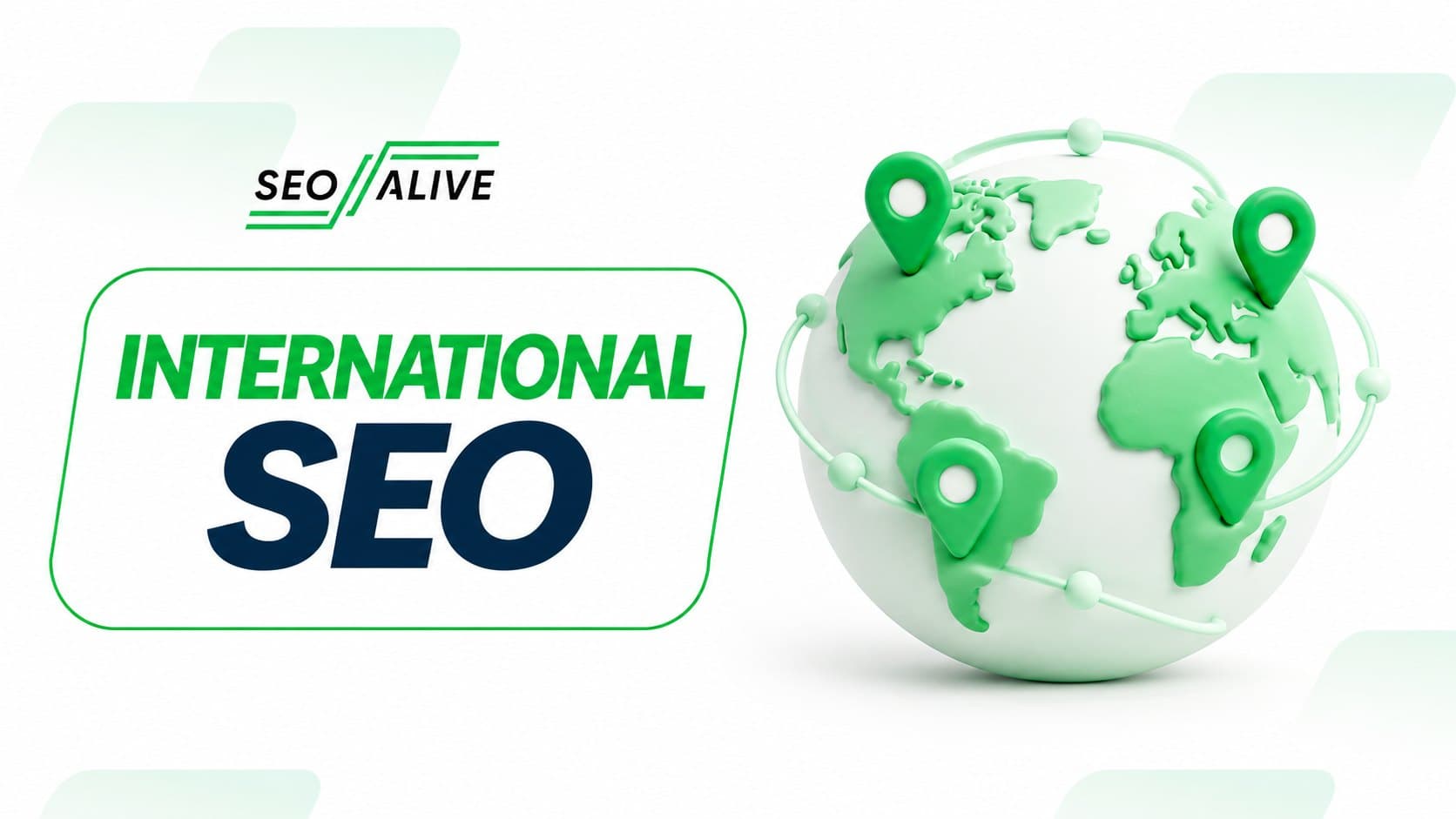
Going global means more than translating your pages. You need the right URL structure, correct hreflang, content that fits each market, and an understanding of how AI Overview and LLMs decide which version to cite.
Table of contents
- Key takeaways
- What is international SEO?
- International SEO strategy: where to start
- URL structure: ccTLD vs subdirectory vs subdomain
- hreflang: telling Google which version to serve
- Content localization vs translation
- Search engines beyond Google: Baidu, Naver, Yandex
- How AI Overview and LLMs handle international content
- Keyword research for international markets
- SEO mistakes that tank your international presence
- Frequently asked questions
- What is the difference between international SEO and local SEO?
- Do I need hreflang if I only have English versions for different countries?
- Is a ccTLD always the best choice for international SEO?
- How does AI Overview handle pages in different languages?
- Can I do international SEO without targeting non-Google engines?
International SEO is the practice of optimizing your website so that search engines and AI systems serve the correct language or country version of your pages to each user. It combines technical signals like hreflang and URL architecture with content decisions about localization, keyword research per market, and search engine dominance by region.
An international SEO strategy starts with deciding which markets to enter, choosing a URL structure, implementing hreflang correctly, localizing content (not just translating it), and tracking performance per locale. It also means understanding that Google is not the only search engine that matters: Baidu dominates China, Naver holds nearly half of South Korea, and Yandex leads in Russia.
If you are building the technical foundation for a multi-regional site, our technical SEO service covers hreflang implementation and site architecture in depth.
Key takeaways
- International SEO is localization, not translation. Search intent, keywords, and content expectations differ by country even when the language is the same.
- URL structure matters. ccTLDs, subdirectories, and subdomains each have trade-offs in cost, authority, and geo-targeting signal.
- hreflang is non-negotiable. Google's documentation lists three implementation methods and common mistakes that cause tags to be ignored entirely.
- Google is not universal. Baidu holds 59.26% of search in China, Naver holds 43.71% in South Korea (StatCounter, August 2026).
- AI Overview and LLMs surface localized answers. Proper hreflang and locale-adaptive content help Gemini and ChatGPT cite the correct country version of your page.
What is international SEO?
International SEO is the process of making your website visible to users in multiple countries and languages. It tells search engines which version of a page to show based on the user's location and language preferences. When someone in Germany searches for your product, they should get your German page, not your English one.
The practice covers three pillars: technical configuration (hreflang, URL structure, sitemaps), content strategy (localization, keyword research per market), and search engine awareness (optimizing for Baidu, Naver, or Yandex where they lead). Most guides cover the first two and skip the third. We cover all three, plus how AI Overview and LLMs are changing the rules.
If your expansion involves specific cities or regions within a country, our local SEO guide complements this with Google Business Profile and “near me” strategy.
International SEO strategy: where to start
A working international SEO strategy answers four questions before you write a single line of hreflang code. Which markets have demand for what you offer? Which languages do you need? What URL structure fits your resources? How will you measure success per market?
Start with market research. Use search volume data to confirm demand in each target country. The keyword “international seo” has a monthly search volume of 3,000 in the US with a keyword difficulty of 36, while “international seo strategy” gets 1,400 monthly searches at a difficulty of 24 (internal sources, 2026). These numbers tell you the topic has real demand and that competition is moderate.
Then prioritize. Entering five markets at once with shallow content in each is worse than entering two markets with properly localized content. Pick the markets where you already have traction, revenue, or clear demand signals, and expand from there.
URL structure: ccTLD vs subdirectory vs subdomain
Your URL structure is the foundation of international SEO. It affects how search engines understand your targeting, how authority flows between versions, and how much effort it takes to maintain. There are three main options.
| Structure | Example | Geo-targeting | Authority | Cost |
|---|---|---|---|---|
| ccTLD | example.fr, example.de | Strongest | Independent per domain | High |
| Subdirectory | example.com/fr, example.com/de | Moderate (hreflang) | Shared (same domain) | Low |
| Subdomain | fr.example.com, de.example.com | Moderate (hreflang) | Partial | Medium |
ccTLDs (country-code top-level domains like .fr, .de, .jp) send the strongest geographic signal. Google uses the country code as a targeting signal by default. The trade-off: each domain builds authority independently, and you need backlinks for every country. This works for companies with local teams and budget per market.
Subdirectories (example.com/fr/) keep everything on one domain, so backlinks to any version benefit the whole site. They are cheaper to maintain and easier to scale. For most companies, this is the right default.
Subdomains (fr.example.com) sit in between. They share some authority with the root domain but are treated as separate entities for many ranking purposes. They make sense when you need different infrastructure per market but want to keep a single brand domain.
hreflang: telling Google which version to serve
Hreflang is the HTML attribute that tells Google which language and region version of a page to show to which users. Without it, Google may still find your alternate pages, but the official guidance is explicit: “it is usually best for you to explicitly indicate your language- or region-specific pages” (Google Search Central, updated December 2025).
Google supports three implementation methods: HTML link tags in the <head>, HTTP headers (for non-HTML files like PDFs), and XML sitemap entries. All three are equivalent from Google's perspective. Pick one and implement it consistently.
Here is the hreflang implementation from Google's own documentation, showing a site with US, UK, generic English, and German versions plus an x-default fallback:
<link rel="alternate" hreflang="en-gb"
     href="https://en-gb.example.com/page.html" />
<link rel="alternate" hreflang="en-us"
     href="https://en-us.example.com/page.html" />
<link rel="alternate" hreflang="en"
     href="https://en.example.com/page.html" />
<link rel="alternate" hreflang="de"
     href="https://de.example.com/page.html" />
<link rel="alternate" hreflang="x-default"
     href="https://www.example.com/" />
The x-default value catches users whose language settings don't match any of your specified versions. Google recommends it for language selector pages and auto-redirecting homepages.
Three mistakes break hreflang silently. Missing return links: if page X points to page Y, page Y must point back to page X, or Google ignores both. Incorrect language codes: specifying a country code alone (like “be” for Belgium) is invalid because Google reads it as the Belarusian language code. Reserved region codes: using codes like “EU”, “UN”, or “UK” has no effect on Google Search (Google Search Central, 2025).
Content localization vs translation
Localization means doing keyword research in each market, adapting content to local search intent, and respecting cultural and regulatory differences. The difference matters because search behavior changes by country even when the language stays the same.
Someone searching for “sneakers” in the US and someone searching for “trainers” in the UK are looking for the same product, but the keyword is different. A German user searching for “Handy” means “mobile phone,” not the English word “handy.”
If you translate your English keyword research into German, you miss the actual terms German users type. This is where most international SEO efforts fail. Teams translate the content, keep the same keyword strategy, and wonder why they don't rank. The content reads correctly but doesn't match what users in that market search for.
Search engines beyond Google: Baidu, Naver, Yandex
Google holds 91.1% of global search engine market share as of August 2026 (StatCounter), but that dominance is not uniform. In several major markets, Google is not the default, and optimizing only for Google means leaving traffic on the table.
| Country | Dominant engine | Share | Google's share |
|---|---|---|---|
| China | Baidu | 59.26% | 1.41% |
| South Korea | Naver | 43.71% | 46.6% |
| Russia | Yandex | Leading | Secondary |
Baidu dominates Chinese search with 59.26% market share, while Google sits at 1.41% (StatCounter China, August 2026). Baidu has its own crawling and indexing rules, prefers sites hosted in China, and requires an ICP license (a government-issued permit for websites operating in China). Content must comply with Chinese internet regulations.
Naver holds 43.71% of search in South Korea, where Google leads with 46.6% (StatCounter South Korea, August 2026). The two engines are nearly tied, which means you need to optimize for both. Naver relies heavily on its own content ecosystem (blogs, cafes, shopping) and treats external websites differently from Google.
Yandex leads in Russia with a meaningful share globally (StatCounter, August 2026). It has its own ranking algorithms, webmaster tools, and preferences for Russian-language content hosted on .ru domains.
If your international strategy includes China, South Korea, or Russia, you need market-specific SEO, not a Google-only playbook.
How AI Overview and LLMs handle international content
When a user in Spain asks Gemini a question and a user in Mexico asks the same question, Gemini can surface different answers. The same applies to ChatGPT, Perplexity, and Microsoft Copilot. How do these systems decide which version of your content to cite?
LLMs rely on the same signals that help Google serve the right locale version: hreflang, localized content, and locale-adaptive pages. If your hreflang tags clearly map your Spanish version for Spain (es-ES) and your Spanish version for Mexico (es-MX), an AI system extracting content for a user in Mexico is more likely to pull from the correct page.
Google has published official guidance on optimizing for generative AI search, recommending structured content, clear page metadata, and what they call “preferred sources” (Google Search Central: Optimizing for generative AI). The same principles that help Google understand your international pages help AI Overview cite them correctly.
The practical implication: localization is now doubly important. A translated page with no market-specific content may rank in Google for the right country (hreflang does that), but an LLM is less likely to cite it because the content doesn't add anything the English version doesn't already say. A localized page with original data, local examples, and market-specific answers is more likely to be the source an AI system extracts and cites.
At SEO Alive, we audit how your localized pages appear in AI-generated answers across markets. Learn more about our GEO and AI services, get cited in AI Overview across every market, or see how Perplexity cites your international content.
Keyword research for international markets
Keyword research for international SEO cannot be done by translating your existing keyword list. Search volume, competition, and user intent vary by country. The same product category may have completely different search terms in two countries that share a language.
Start with local keyword tools that cover your target market and let you query search volumes by country. The key is to research in the target language, not in English. A German keyword discovered through an English seed term will miss the terms German users type.
Then map intent per market. A keyword with transactional intent in the US might have informational intent in Japan. The same term might be used by different audiences in different countries. Build a keyword map per locale, not a single global list.
SEO mistakes that tank your international presence
Most international SEO failures come from a small set of repeated mistakes. Here are the ones we see most often:
- Auto-redirecting based on IP without a fallback. Googlebot crawls from US IP addresses. If you auto-redirect every US visitor to your US page, Googlebot may never see your other language versions. Always provide a manual language selector and use cookies, not forced redirects, for returning visitors.
- Ignoring bidirectional hreflang. Each page must link to all other versions, including itself. If your French page points to your English page but the English page doesn't point back, Google ignores the annotation. This is the most common hreflang error listed in Google's documentation.
- Using the same content across locales. Duplicate content with minor translation changes offers no value to users or to AI systems. Each locale version needs its own content strategy.
- Forgetting non-Google engines. If you are targeting China, South Korea, or Russia, Google-only optimization means you are invisible on the engine most users actually use.
Frequently asked questions
What is the difference between international SEO and local SEO?
International SEO targets multiple countries or languages from a single site structure, while local SEO targets users in a specific geographic area within one market. International SEO deals with hreflang, multilingual content, and URL structure across borders. Local SEO deals with Google Business Profile, local citations, and “near me” intent. They overlap when a business operates in specific cities across multiple countries.
Do I need hreflang if I only have English versions for different countries?
Yes. If you have separate English pages for the US, UK, and Australia with regional variations (pricing, shipping, currency), hreflang tells Google which version to serve. Without it, Google may show the wrong version or consolidate them as duplicates. Google's documentation specifically lists this as a recommended scenario for hreflang.
Is a ccTLD always the best choice for international SEO?
No. ccTLDs send the strongest geo-targeting signal, but they require building authority from scratch for each domain. For most companies, subdirectories (example.com/fr/) are the better default because they share domain authority and are easier to maintain. Choose ccTLDs when you have local teams, significant budget per market, and a long-term commitment to each country.
How does AI Overview handle pages in different languages?
AI Overview surfaces content that best matches the user's query, locale, and language settings. Pages with correct hreflang, market-specific content, and structured data are more likely to be cited. Google's official guidance on generative AI optimization recommends clear page metadata and well-structured content. A translated page with no localization is less likely to be cited than a page with original, market-specific answers.
Can I do international SEO without targeting non-Google engines?
Only if your target markets are outside China, South Korea, and Russia. Baidu holds 59.26% of search in China and Naver holds 43.71% in South Korea (StatCounter, August 2026). If those markets are in your expansion plan, you need engine-specific optimization. For most other markets, Google's dominance (91.1% globally) means a Google-first approach is sufficient.
Ready to make your brand visible across markets and AI systems? We audit how your localized pages appear in Google, AI Overview, and LLM citations, then build the technical and content foundation to improve both.
Start your international SEO strategy with SEO Alive!