An answer engine does not hand you ten links. It gives one answer and names a few sources. Answer engine optimization is the work of being one of them.
This guide covers what AEO is, how it differs from SEO and from GEO, what actually happens between a question and a citation, and the practices that make a difference to get cited.
Table of contents
What is answer engine optimization?
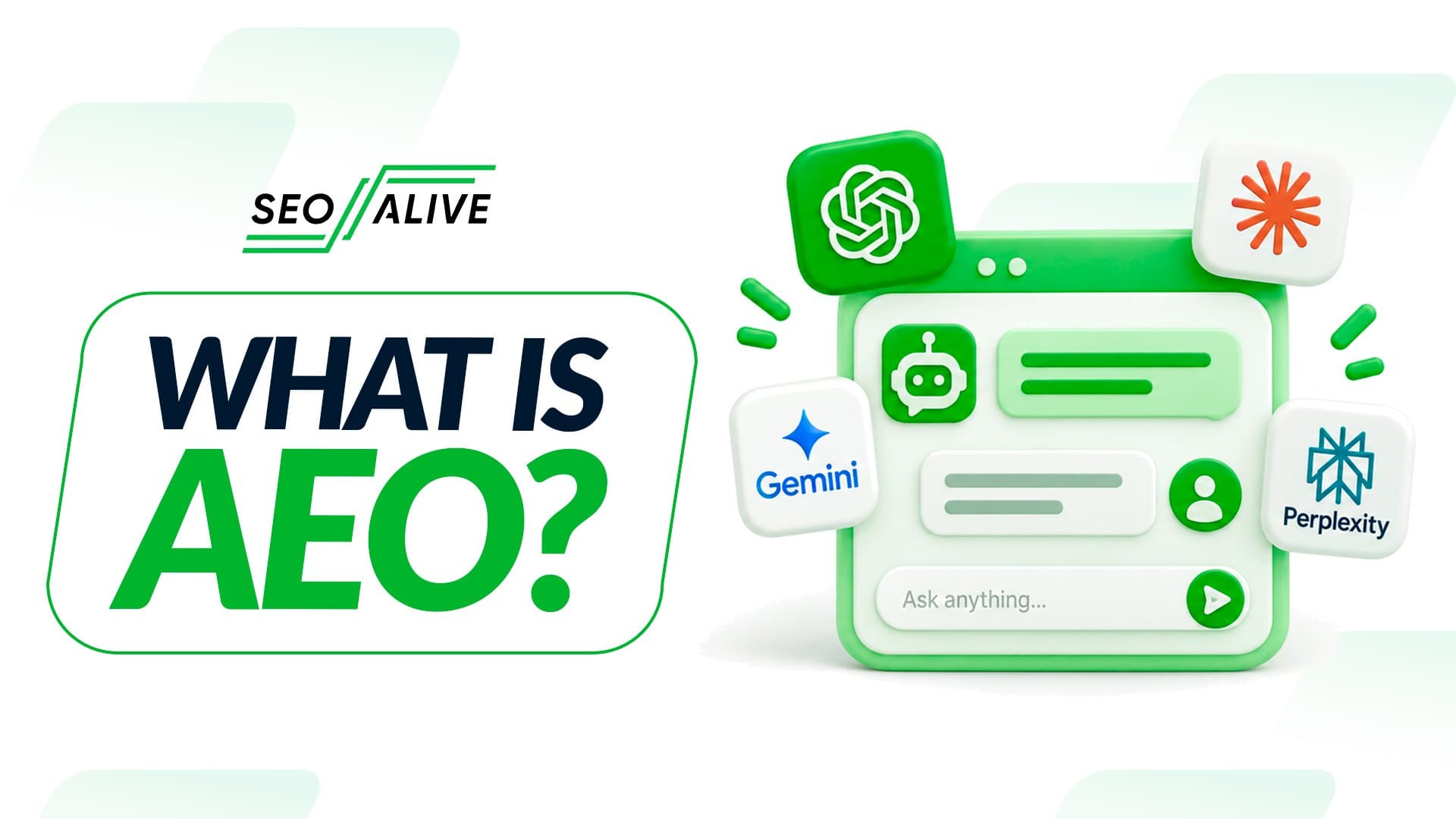
Answer engine optimization (AEO) is the practice of preparing content so that an answer engine can extract a correct, self-contained answer from it and attribute that answer to you.
An answer engine is any system that responds to a question with a resolved answer rather than a list of documents: Google's AI Overviews and featured snippets, ChatGPT, Perplexity, Gemini, Copilot, Alexa and Siri. They differ in how they retrieve and how they write, but they share one behaviour that changes the job: the user's need is met on the engine's surface, and your page is credited, not visited.
That single fact reorders the priorities. Ranking is still useful, because most engines retrieve from the same index they always did. But ranking is no longer where work ends. The finish line is the sentence that quotes you.
SEO vs AEO vs GEO: the honest comparison
These three acronyms overlap enough that vendors use them interchangeably, which helps nobody. The useful distinction is what each one optimizes for:
| SEO | AEO | GEO | |
|---|---|---|---|
| Goal | Rank a page | Own the answer to a question | Be cited inside generated text |
| Unit of work | The page | The passage | The entity and its evidence |
| Surface | Blue links | Featured snippets, People Also Ask, voice | ChatGPT, Gemini, Perplexity, Copilot, AI Overviews |
| Success looks like | Position and clicks | Your wording is the answer | Your brand is named and linked |
| Main lever | Relevance and authority | Extractability | Corroboration across sources |
| Fails when | Nobody links to you | The answer is buried in prose | Only your own site says it |
Read the table as three layers of the same job rather than three products. AEO is the passage-level craft; GEO is the brand-level one; SEO is the foundation both stand on. A page that nobody can find is not going to be quoted, and a brand that only its own website talks about is not going to be recommended.
If you are choosing where to start in practice, start with AEO. It is the cheapest of the three, it works on content you already have, and the gains show up in classic SERP features as well as in AI answers.
How does answer engine optimization work?
Four things happen between a question and a citation. Optimizing blindly for "the algorithm" wastes effort; each step fails for a different reason.
1. The question is rewritten. Engines rarely search for what the user typed. A conversational question becomes several retrieval queries, often more explicit than the original. This is why keyword-exact pages underperform: the engine is matching meaning, not strings, and it may query for terms your page never uses. This is called query fan-out, and Google uses the term explicitly for AI Mode.
2. Candidates are retrieved. Most answer engines still lean on a conventional index (their own crawl, Bing's, or Google's, often in combination) plus a live fetch. Being retrievable is still SEO: crawlable, indexed, reasonably authoritative, and fast enough to fetch.
3. Passages are selected. The engine does not read your page the way a person does. It splits it into chunks and picks the ones that answer the rewritten query on their own. A chunk that needs the previous three paragraphs to make sense loses to a chunk that does not. This step is where AEO is won or lost.
4. The answer is written and attributed. The model composes a response from the selected passages and decides whom to name. Claims that appear in several independent sources tend to survive; claims that appear only on your own site get used cautiously or dropped. This is the step where GEO (off-site corroboration) starts to matter more than anything on your page.
Answer engine optimization best practices
Everything below targets step 3, because that is the step you fully control.
Answer in the first two sentences. Put the direct answer immediately under the heading that asks the question, then explain. If the first line of a section is a preamble, the extractable part of that section is a preamble.
Make every section self-contained. No "as we saw above", no pronouns pointing at earlier paragraphs, no numbers whose unit was defined three headings ago. Each block should survive being lifted out of the page, because that is exactly what happens to it.
Use question-shaped headings. "How does answer engine optimization work?" matches the rewritten query far more closely than "Mechanics". You are not writing for a table of contents, you are labelling passages for a retriever.
Write claims a reader can verify. Something specific, like a version number, a documented behaviour, or a named source, gives a reader something to check and gives an engine something to lift. A superlative gives neither. Add the date to anything that can go stale: model versions, market share, retrieval behaviour.
Add structured data that mirrors the visible text. FAQPage, HowTo, Article, Organization, Product. Schema does not make an engine quote you, but it removes ambiguity about what the passage is and who wrote it. The one hard rule: the markup must repeat what is on the page, word for word. Schema that says something the page does not is the fastest way to get ignored and, in Google's case, penalised.
Write tables and lists for the cases that deserve them. Comparisons, specifications, steps and prices extract far better as a table than as prose. Not everything is a table; comparisons almost always are.
Name things the way your readers name them. Entities like products, people, methods and places need consistent naming across your site and off it. An engine that cannot resolve "our platform" into a named thing cannot attribute anything to it.
Do not gate what you want quoted. Content behind a form, a cookie wall, or a JavaScript render that only runs after interaction is content the retriever does not see.
Answer engine optimization examples
Three rewrites that show the difference. The information is identical; the extractability is not.
Before: "Delivery times depend on several factors. Every project is different, and after our discovery call we will be able to give you a tailored timeline that fits your needs and objectives." After: "A technical audit takes two to three weeks. Content work starts in week four, and the first movement in citations is usually visible between month two and month four, depending on how often the engines re-crawl the site." The first paragraph cannot be quoted, because it contains no answer. The second one can, and it is the kind of sentence an engine reuses verbatim.
Before: a heading reading "Our methodology", followed by six paragraphs of narrative. After: a heading reading "How long does GEO take to show results?", followed by a two-sentence answer and then the six paragraphs. Same content, one extra heading, and now there is a passage that matches a real question.
Before: a comparison written as prose across four paragraphs. After: the same comparison as a table with one row per criterion. Tables survive chunking almost intact, and engines reproduce them readily — which is why the SEO/AEO/GEO comparison above is a table and not three paragraphs.
How to measure AEO
The classic dashboard does not see any of this. Impressions in Search Console do not tell you whether your wording was reused, and a citation inside ChatGPT produces no referrer at all. Three things are worth tracking:
- Presence. For a fixed set of questions that matter to your business, how often does each engine name you? Run the same prompts on a schedule and record the answer, not an impression estimate. This is what we built SEOcrawl's AI visibility tracking for.
- Share of the answer. When you are cited, are you the source of the substance or a footnote at the end? One is a recommendation; the other is a link.
- Assisted demand. Brand search volume and direct traffic move before anything shows up in an attribution model. They are lagging and noisy, but they are real.
Set a baseline before you change anything.
Where AEO stops working
Being honest about the limits is part of the method.
AEO cannot make an engine recommend a brand that nothing off-site corroborates. If the only page on the internet saying you are good at something is your own, a model will hedge. And that is correct behaviour on its part. Fixing it is GEO and PR work, not formatting. The GEO best practices guide covers that method end to end, and LLM SEO (LLMO) is the brand-level version of the same problem.
AEO does not recover the clicks that the answer absorbed. Some queries (definitions, conversions, opening hours) are answered on the surface and never sent anywhere. Optimizing them is worth it for visibility and brand recall, not for sessions. Choose which of your queries are transactional enough to still produce a visit.
And AEO does not survive being wrong. An engine that quotes an incorrect claim from your site and gets corrected by another source will stop quoting you. Accuracy is a ranking factor now more than ever.
If you want a second pair of eyes on where your content stands, our SEO audit covers extractability and structured data alongside the technical work.
Frequently asked questions
What is answer engine optimization (AEO)?
Answer engine optimization is the practice of preparing content so that an answer engine can extract a correct, self-contained answer from it and attribute that answer to you. Answer engines include Google AI Overviews and featured snippets, ChatGPT, Perplexity, Gemini, Copilot and voice assistants. The goal is to be the source that is quoted, not one of the links on a results page.
How does AEO work, step by step?
Four steps happen between a question and a citation. The engine rewrites the question into one or more retrieval queries; it retrieves candidate documents, usually from a conventional index; it splits those documents into passages and picks the ones that answer the query on their own; and it writes an answer from the selected passages, deciding whom to name. AEO works on the third step, making every section self-contained and directly answering a question.
What is the difference between AEO, GEO and SEO?
SEO optimizes a page to rank. AEO optimizes a passage so it can be lifted out and used as the answer. GEO (generative engine optimization) optimizes a brand and its evidence so that generative engines name it. They are three layers of the same job rather than three separate products.
Does schema markup help with AEO?
Yes, but indirectly. Structured data such as FAQPage, HowTo, Article and Organization removes ambiguity about what a passage is and who wrote it, which helps an engine attribute it. It does not force a citation. The hard rule is that the markup must repeat what is visible on the page word for word; schema that claims something the page does not say is ignored and, in cases of misleading rich results, can trigger a manual action.
How do you measure answer engine optimization?
Citations inside AI answers produce no referrer, so Search Console and analytics cannot see them. Track three things instead: presence (how often each engine names you for a fixed set of questions, run on a schedule), share of the answer (whether you are the substance or a footnote), and assisted demand (brand search and direct traffic). Take a baseline before making changes.